Boaz’s move to Zikhron Yaakov
Black BoxBoaz’s move to Zikhron Yaakov turns Alexander Gideon’s offer of help into a practical experiment in independence. Rather than accept a place in America, Boaz takes up residence in an abandoned, deteriorating house near Zikhron, where paid restoration work, agriculture, and communal life begin to replace the restrictions and conflicts associated with Kiryat Arba. The move does not end the family’s disputes; it gives them a new setting, and a different test of whether support can coexist with freedom.
The offer and the choice
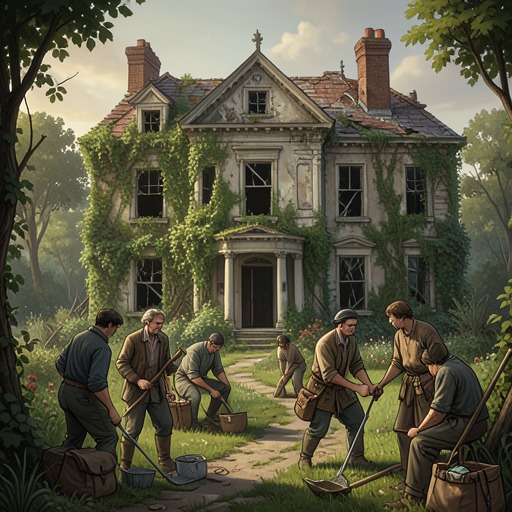
In a letter dated July 23, 1976, Alexander replies to a brief note from Boaz by acknowledging that his son wants to live independently and make his own decisions. He proposes setting aside, for the time being, the money already held by Michel Sommo and offers two alternatives. In the United States, Boaz could receive a ticket, accommodation, a job, and eventually the chance to study; Alexander mentions optics as one possible line of work, while warning that language would be an initial difficulty. The other possibility is an empty house near Zikhron Yaakov, then in poor condition, which Boaz could restore gradually.
The Zikhron offer makes assistance conditional in a distinctive way: Alexander would pay Boaz a fair monthly wage and cover building materials and related expenses, but Boaz would be free to decide what he wanted to do. He could invite others to live in the house, and there was scope for agriculture as well as repair work. Instead of asking his father for permission at each step, Boaz was told to take his decision to Roberto di Modena, a lawyer in the same Jerusalem office as Manfred Zakheim. Alexander specifically instructed him to approach di Modena directly, and said arrangements had already been made to put either choice into effect.
Leaving Kiryat Arba
Boaz chose the house in Israel. In a later message, Roberto di Modena informed Alexander that he had arranged Boaz’s installation in the property, dealt with formal difficulties, provided the money set aside for initial arrangements, and would pay him monthly as instructed. Boaz had been in Zikhron since the previous day. The message also noted that di Modena’s business partner was furious, an indication that the arrangement was not received as a neutral family favor by everyone around it.
The move meant leaving Kiryat Arba, where Michel had placed Boaz. Michel’s sister Rahel, writing to Ilana, reports that Michel had told her Boaz was leaving the settlement for the ruined house near Zikhron, on Alexander’s decision. She urged Ilana not to obstruct the move and said her husband Yoash would visit to see what help might be needed. Her letter registers the family’s anxiety about Ilana’s renewed contact with Alexander, but also makes clear that Boaz’s change of residence had become a concrete event requiring practical support.
Boaz himself later explains why Kiryat Arba had not suited him. Although he acknowledges its attractive setting, he says that its religious and political outlook was not his: he did not share the belief that the state should continue conquering Arab territory and taking land from its inhabitants. He preferred that Arabs and Jews be left to live separately without interference. His departure is therefore both a personal break from Michel’s placement and a refusal of the ideological environment he associated with it.
Repairing the house and making a commune
The abandoned property becomes more than a place to live. In describing his new circumstances to Ilana, Boaz presents a routine built around repair work, paid employment, and a vegetable garden. He says that the house is being looked after in return for monthly wages and that he expects the work to remove another ruin from the country. He invites Ilana to stay, offering work, food, and the possibility of bringing Yifat. His invitation is practical rather than ceremonial: there is work to do, including cooking and, eventually, caring for goats.
The commune takes shape through small, specific improvements. In a later letter to Michel, Boaz describes six people working at the property, permits for water and electricity arranged through the local council, and sprinklers, plants, tools, and chickens bought with money from America. A telescope on the roof is nearly finished. He says a clean room has been prepared for Ilana and Yifat, and that he would provide a kosher area if Ilana wanted one. His account presents communal life as a set of negotiated arrangements: people may follow their own preferences so long as they work, treat one another decently, and do not impose their beliefs on others.
The invitation extends to Michel as well. Boaz welcomes him to visit and leaves open the possibility of a contribution, while stressing that the household should not become another place where one person dictates how everyone else must live. He has built swings, a slide, and a sandbox for Yifat, and says Ilana could also find work there. The property’s new order is meant to accommodate family members without requiring them to share a single religious or political outlook.
Family ties and changed conduct
The move does not make Boaz self-sufficient in the sense of needing no one. Alexander supplies the initial funds and promises a wage; later, Boaz asks Michel to let Ilana and Yifat visit. But the form of support changes. The house gives Boaz responsibility for repairs and daily work, while allowing him to set the terms of communal life. He presents this freedom as different from the authority he experienced in Jerusalem and Kiryat Arba, not as a rejection of every family connection.
Boaz also credits Michel with influencing his conduct. In his letter, he says that he has learned from Michel not to hit people, even when police and inspectors came around and caused trouble. He presents this restraint as evidence that he has changed, and as a reason Michel should not reduce him to the role of a hoodlum. His appeal joins gratitude to criticism: the help Michel has given, he argues, cannot justify expecting everyone to become like him.
The first family assessment of the new settlement is cautiously positive. Yoash visits, helps repair wire netting around the chicken run, and offers agricultural advice. He returns with the impression that Boaz is doing very well in the commune he is establishing. Rahel proposes bringing the children on a future visit and sees no reason Ilana, Michel, and Yifat should not come too. The house that began as Alexander’s alternative to America has thus become a possible meeting place, though the family’s unresolved disagreements remain.
Land, money, and the meaning of the move
The move unfolds amid a wider contest over money and land. Earlier, the Sommos had requested substantial funds for their mortgage, additional rooms, the children’s future, and the purchase and renovation of Alkalai House in Hebron, which they described as an effort to regain a Jewish property through payment rather than violence. Michel’s political activity also connected him to organizations campaigning over territory and land purchases. These plans form a charged background to Alexander’s decision to support Boaz’s restoration project, but they are not the same undertaking: Boaz’s letter emphasizes work on the property and freedom from interference, not a program for political land acquisition.
That distinction sharpens the event’s significance. Alexander’s resources make Boaz’s independence possible, yet the arrangement still depends on money, lawyers, wages, permits, and family consent. Boaz tries to define a different measure of success: not territorial ambition or obedience to a prescribed way of life, but a repaired house, productive work, and room for people to differ. The move begins as a father’s offer, becomes Boaz’s chosen residence, and develops into a fragile communal project whose promise lies in the everyday labor of making space for others.